Saving swifts, understanding climate
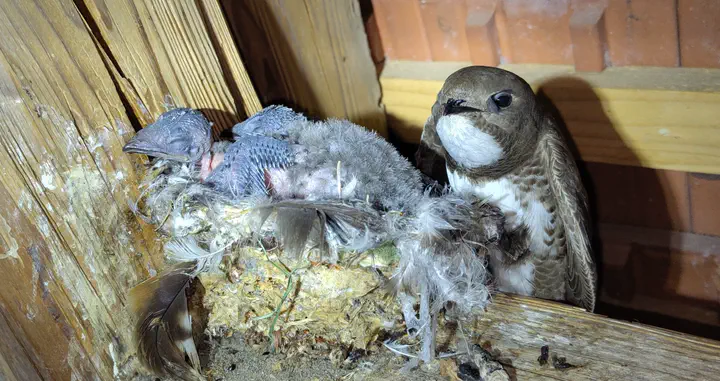
Saving swifts, understanding climate: a Europe-wide rescue centre study
If your centre collects data on swifts, we would be very interested in collaborating. Please complete our short survey to help us map available data and build this network.
We actively welcome collaboration from wildlife rescue centres across Europe.
🔥 2026 — an extraordinary summer, and a call to your centre
The summer of 2026 has been extraordinary across Europe: long, intense and repeated heatwaves broke temperature records in many countries. We know that many wildlife rescue centres have been on the front line, receiving unprecedented numbers of swift nestlings and fledglings that had jumped from overheated nests. If your centre went through this — first of all, thank you. Your 2026 data are especially valuable and can help us quantify, at continental scale, the impact of this exceptional season on European swifts.
📅 Please complete the survey by 31 October 2026
To include the extraordinary 2026 season in our first analyses, we kindly ask you to fill in the survey by 31 October 2026. This gives us time to map the participating centres before starting the targeted data-sharing and analysis phase. If you cannot meet this deadline but still wish to take part, please contact us at giulia.masoero@vogelwarte.ch — we will find a way to include you.
The survey is currently available in 23 languages.
Native translations (prepared with native speakers — please prefer these if available):
English | Deutsch | Español | Français | Italiano
Machine translations of the original English form (some wording may not be perfectly accurate — please contact us at giulia.masoero@vogelwarte.ch if anything is unclear):
Bulgarian | Croatian | Czech | Danish | Dutch | Finnish | Greek | Hungarian | Norwegian | Polish | Portuguese | Romanian | Serbian | Slovak | Slovenian | Swedish | Turkish | Ukrainian
Please, help us by sharing the survey as much as possible!
📝 What we ask you (5–10 minutes)
The initial survey collects preliminary information only — no swift data at this stage. In particular we ask:
- Name and country of your centre, plus a contact person
- Whether you keep records of swift admissions and, if so, which species (common swift Apus apus, pallid swift Apus pallidus, Alpine swift Tachymarptis melba)
- Which years are covered by your records
- What kind of information you record for each swift (age, admission date, cause of admission, outcome, etc.)
- Whether you would be open to collaborating in a later, targeted data-sharing phase
Filling in the survey does not commit you to sharing data. It simply helps us map who is out there and what data exist across Europe.
🎁 What you get in return
Rescue centres are the backbone of this project, and we know your time is precious. Centres that take part will benefit from:
- Recognition — with your permission, your centre will be listed on this page as a project partner.
- Co-authorship — centres that later share data will be invited as co-authors on the resulting publications.
- Feedback — we will share the aggregated results with you before publication.
- A stronger voice for swifts — your data will feed evidence-based recommendations for the conservation of swift breeding colonies at European scale.
Overview
Climate change is increasing the frequency and intensity of extreme weather events across Europe, with potentially severe consequences for aerial insectivores such as swifts. In recent years, wildlife rescue centres have reported sudden spikes in the number of nestlings and fledglings admitted during heatwaves and other extreme events. However, these patterns remain poorly quantified at large spatial scales.
This project aims to leverage data collected by wildlife rescue centres across Europe to investigate how climatic conditions influence the vulnerability of swift species, including the common swift (Apus apus), pallid swift (Apus pallidus), and Alpine swift (Tachymarptis melba).
Objectives
The main goals of this project are to:
- Quantify how extreme weather events (e.g. heatwaves, storms) affect rescue rates of swift nestlings and fledglings
- Identify spatial and temporal patterns in rescue admissions across Europe
- Determine environmental drivers associated with peaks in rescue events
- Provide evidence-based recommendations for the conservation and management of swift breeding colonies
Approach
We are building a collaborative network of wildlife rescue centres that collect data on swift admissions. The project follows a two-step approach:
- An initial survey — the one linked above — to identify available datasets and willingness to collaborate.
- Targeted data sharing and analyses, only after a formal collaboration agreement with each participating centre. Data sharing is opened up on a case-by-case basis and in full respect of GDPR and data-protection rules.
By combining rescue data with high-resolution climatic information, we aim to uncover the mechanisms linking extreme weather to increased mortality risk in young swifts.
The team behind the project
- Mattia Brambilla — University of Milano, Italy
- Alejandro Corregidor-Castro — University of Padova, Italy
- Giulia Masoero — Swiss Ornithological Institute, Switzerland
✉️ Get in touch
You run a rescue centre? Fill in the survey above — or, if you have questions first, just drop us a line. We’re happy to talk.
You want to help us spread the word? Share the survey with rescue centres, ringers, ornithological societies or wildlife-friendly friends across Europe. The wider the network, the stronger the study.
You can help us translate the form into a language we don’t yet cover? Please contact us — we will gladly add it.